


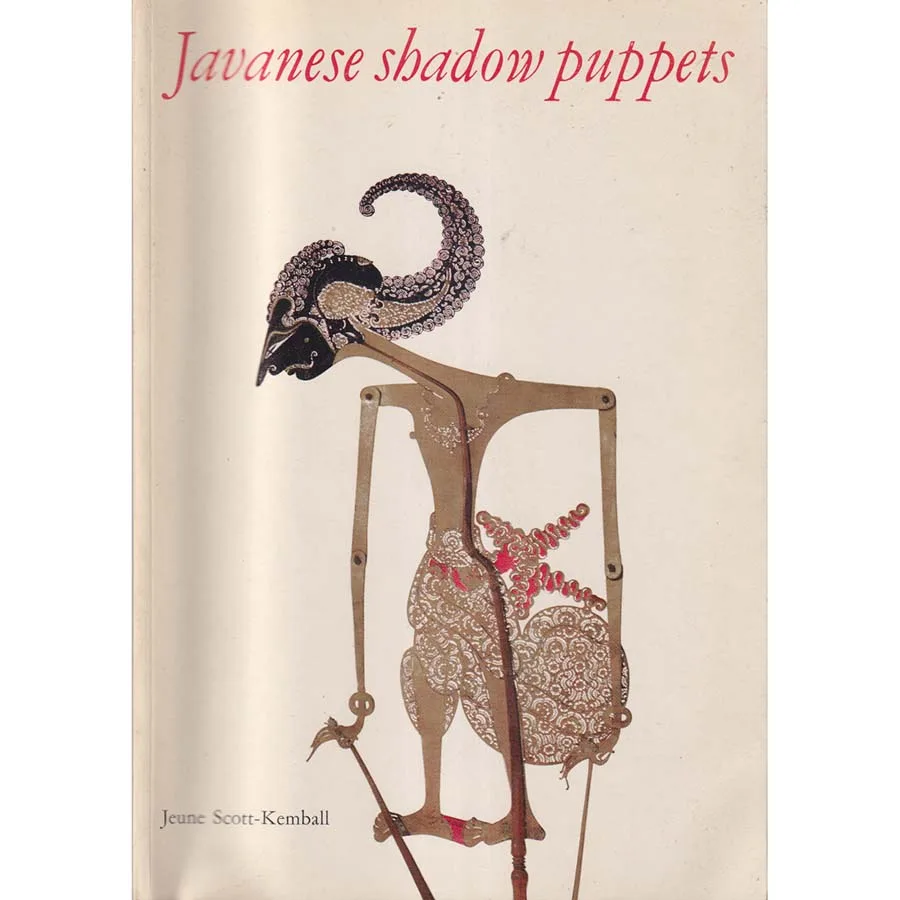
Javanese Shadow Puppets
Publisher: The Trustees of the British Museum
Format: Paperback
ISBN: 071411507X
Javanese Shadow Puppets (1970) by Jeune Scott-Kemball – The Trustees of the British Museum – Fair Condition
There are puppets, and then there are Javanese shadow puppets, which rather raise the standard.
No socks.
No strings.
No cheerful wooden heads bobbing about.
Instead you get fantastically intricate figures cut from hide, painted and pierced with extraordinary detail, manipulated behind a screen to cast dramatic shadows while ancient epics, music, comedy, philosophy and the occasional divine intervention unfold over several hours.
Javanese Shadow Puppets, written by Jeune Scott-Kemball and published in 1970 by The Trustees of the British Museum, is an introduction to the remarkable tradition of Indonesian shadow theatre, particularly the art generally known as wayang kulit.
The puppets themselves are extraordinary objects.
Flat, highly stylised and often elaborately decorated, they can represent gods, kings, warriors, demons, servants, heroes and assorted supernatural complications. Their exaggerated profiles, extraordinarily long arms and intricately perforated bodies may seem strange at first glance, but every element belongs to a visual language developed over centuries.
Put one behind an illuminated screen and suddenly the peculiar-looking object becomes something entirely different.
The performance is traditionally controlled by a dalang, the master puppeteer who handles the figures, provides voices, directs the action and effectively runs the entire theatrical universe from behind the screen. This seems an unreasonable workload for one person, particularly as audiences have historically expected performances to continue for many hours.
Anyone complaining about a long film should probably avoid mentioning it to a dalang.
The stories are frequently drawn from the great Hindu epics, particularly the Ramayana and Mahabharata, but Javanese shadow theatre developed its own characters, interpretations and traditions. Gods and heroic princes coexist with comic servants and local references, creating performances capable of being simultaneously religious, philosophical, political and extremely entertaining.
Accompanied by gamelan music, the result is not simply puppetry but a complete theatrical form in which music, storytelling, ritual, visual art and performance are inseparable.
Scott-Kemball’s book belongs to the British Museum tradition of concise scholarly publications designed to explain objects properly rather than merely place them in a glass case with a label saying “puppet, Indonesia”.
As such, it makes an appealing little introduction to both the craftsmanship of the figures and the cultural tradition behind them.
Published in 1970, it also has the pleasing atmosphere of an older museum handbook: serious, compact and produced at a time when visiting a museum frequently resulted in purchasing a slim booklet that subsequently remained on a bookshelf for the next fifty years.
This particular copy appears to have experienced something rather more physically demanding.
Condition is Fair, chiefly because the book is slightly scrunched up, as though it has been quashed in a box for a couple of decades.
Which, to be fair, may be exactly what happened.
It is not destroyed, dismembered or reduced to archaeological fragments. It is simply somewhat compressed and rumpled, displaying the unmistakable appearance of a book which has spent a prolonged period losing an argument with heavier objects.
Collectors requiring a pristine museum-shop specimen should therefore continue their search.
Readers who merely want the book and are prepared to accept that it has endured a lengthy period of involuntary three-dimensional storage may find it considerably more appealing.
There is something oddly appropriate about a book devoted to flat puppets having itself become slightly flatter than originally intended.
ISBN 071411507X.
Ideal for collectors of puppetry, Indonesian art, theatre history, museum publications, Asian culture, folk traditions or anyone fascinated by the fact that an object made from a piece of leather can become a god, demon or warrior simply by putting a lamp behind it.
Also suitable for readers who appreciate vintage museum books with genuine signs of having lived a life rather than spending fifty-six years being treated as sacred relics.
Sold by Crappy Old Books — where the puppets are flat by design, the book is slightly flatter by circumstance, and decades in a box are regarded as provenance rather than a catastrophe.
Keep browsing: See more History books Other books by Jeune Scott-Kemball
